Today was a two therapist day. Actually, two therapists and one in-training. Jennifer, the newest member of Team Oliver, came to observe the first two hours of the morning session. Lindsey, the therapist on duty-- and the person who has been working with Oliver the longest -- gave her lots of helpful hints: what kind of things he likes, how to motivate him, things to watch for; etc. I took some mental notes myself.
Shortly after Oliver was diagnosed I was reminded to always remember that I am the expert on Oliver. That has been good advice sometimes but there is no doubt that I have learned a great deal about Oliver by listening, watching, and talking with his therapists. Last Friday when Oliver had an absolute melt-down brought on by unexpected visitors I looked to Lindsey for advice about how to help him cope. She was right on the money when she suggested that a video might help him focus and calm down. With visitors in the house and my aversion to TV it was probably the last thing I would have tried. But it worked like a charm and I was glad he could find some peace. It is times like this when I see how valuable the in-home program is for us as a family because the truth is, I don't always understand my boy and it helps to have fresh insights and creativity.
To break up a long day of therapy I try to have small, fun activites built into the day. Since Halloween is approaching I hauled the big pumpkin in from the porch and got Oliver to help me carve it and light the candle I had put inside. He was delighted but mostly interested in taking off the lid and putting it back on again like a giant puzzle piece. He also had trouble understanding that the candle, which was roughly muffin shaped, was not actually a cake. Prior to this the only time he had seen a candle was when it sat upon a birthday cake so he was a bit disappointed that this activity didn't involve any eating!
By the time the therapists had come and gone Oliver and I were both exhausted and in need of some fresh air. He has developed a new love for riding in the car -- I know this because he will often bring me my shoes and lead me to the door saying "car." So, to indulge his desire for a ride and need for fresh air Nik took him along to a soccer game with a tupperware dinner of cucumbers, raisins and roasted chicken. He came home with cheeks blushed red with the October air and with the good kind of tired that comes from playing outdoors.
Before bed Oliver was entertained by older brother and his friends who were gearing up to go to a corn maze. They had a scary mask that would have frightened Oliver a year ago but now gave him a thrill. After they tired of chasing him around the downstairs with the mask on Oliver kept retrieving it and handing it to his brother, not wanting the fun to end. He even jumped up one kid's lap (whom he had never met before!) and peered into they eyes of the mask giggling the whole time. It made me smile to see him interact with the big kids that way. Afterwards he fell into an easy sleep and I took the time to sit by his bed, admire him, and be thankful for another Friday at home with my boy.

Friday, October 28, 2005


Wednesday, October 26, 2005
Small Victories
Sometimes I get so caught up in thinking about Oliver's deficits that I forget to take note here of the many small victories that we've had over the last few weeks. One gift, if you can call it that, of autism is that nothing, even the smallest stride forward, is taken for granted. A new word or skill, or the simple act of focused play, is cause for celebration and appreciation.
Oliver has learned to dress and undress himself after only a few days of prompting. We still have to sit behind him and provide occassional direction but he manages to do it fairly well and that is tremendously heartening. After donning each article he is rewarded with cheers and hugs and "Yeah, Oliver! You did it!! What a big boy. I'm so proud of you!" and the smile he delivers tells us that he is proud of himself.
Oliver's verbal skills have also been getting more exercise lately. "I want dinosaur." "I want whistle." "I want balloon." All of these phrases were uttered in the same hour when unplanned guests came to visit and invaded Oliver's play room taking up to play with the various articles that he then requested. Oliver's language ability is something that I have puzzled over. He seems to have a vocabulary stored in his head that rarely gets used. I haven't heard him say dinosaur in over a year but then suddenly there it was. And occassionally he will come out with a sentence that is full and understandable and clearly of his own invention. One day I was pretending that a stuff cow could make all the other noises of the animal kingdom. When I made the sheep's sound he looked at me and said: "That's not a sheep. That's a cow!" I was dumfounded. One day I sneezed and he said: "Gezhundheit!" Some days Oliver will be full of verbals that are clearly understandable and other days all of the syllables of the same words will slide together and like a secret code I have to decipher what he means. And some days he says practically nothing at all; the gibberish reigns.
Why these good days and bad days? What subtle things beyond my comprehension influence him? I wish there were a guidebook written by some wizened old expert like Dr. Sears that said: "If your child is like this, then do this." But there isn't and we do what we can do to piece together the clues we are given. Starting on November the First we will begin experimenting with our diet to determine if there is a possible link between what he eats and his various behaviors. I am overwhelmed at the prospect of changing our eating habits but lucky enough to have a lovely, encouraging diet "coach" who will help us along the way. And I am excited to see if this experiment will yeild some new clues that will help us along the way.
About a year ago Oliver would run to me saying in a breathless sort of way: "I love me!" (meaning "you") and throw his arms around me. I hold the memory of that simple phrase and the feeling of his warm breath on my neck very close to my heart. There are many days when I am tempted to mourn the loss of that phrase. But mostly I feel confident that if we give Oliver all that we can find it in ourselves to give then each day will bring new victories and cause for celebration.
Oliver has learned to dress and undress himself after only a few days of prompting. We still have to sit behind him and provide occassional direction but he manages to do it fairly well and that is tremendously heartening. After donning each article he is rewarded with cheers and hugs and "Yeah, Oliver! You did it!! What a big boy. I'm so proud of you!" and the smile he delivers tells us that he is proud of himself.
Oliver's verbal skills have also been getting more exercise lately. "I want dinosaur." "I want whistle." "I want balloon." All of these phrases were uttered in the same hour when unplanned guests came to visit and invaded Oliver's play room taking up to play with the various articles that he then requested. Oliver's language ability is something that I have puzzled over. He seems to have a vocabulary stored in his head that rarely gets used. I haven't heard him say dinosaur in over a year but then suddenly there it was. And occassionally he will come out with a sentence that is full and understandable and clearly of his own invention. One day I was pretending that a stuff cow could make all the other noises of the animal kingdom. When I made the sheep's sound he looked at me and said: "That's not a sheep. That's a cow!" I was dumfounded. One day I sneezed and he said: "Gezhundheit!" Some days Oliver will be full of verbals that are clearly understandable and other days all of the syllables of the same words will slide together and like a secret code I have to decipher what he means. And some days he says practically nothing at all; the gibberish reigns.
Why these good days and bad days? What subtle things beyond my comprehension influence him? I wish there were a guidebook written by some wizened old expert like Dr. Sears that said: "If your child is like this, then do this." But there isn't and we do what we can do to piece together the clues we are given. Starting on November the First we will begin experimenting with our diet to determine if there is a possible link between what he eats and his various behaviors. I am overwhelmed at the prospect of changing our eating habits but lucky enough to have a lovely, encouraging diet "coach" who will help us along the way. And I am excited to see if this experiment will yeild some new clues that will help us along the way.
About a year ago Oliver would run to me saying in a breathless sort of way: "I love me!" (meaning "you") and throw his arms around me. I hold the memory of that simple phrase and the feeling of his warm breath on my neck very close to my heart. There are many days when I am tempted to mourn the loss of that phrase. But mostly I feel confident that if we give Oliver all that we can find it in ourselves to give then each day will bring new victories and cause for celebration.
Monday, October 24, 2005
Moving forward
We have a new at-home therapist who will round out Oliver's service program. He now receives therapy for various amounts of time six days a week from five different therapists. This is in addition to the specialists at school: his teacher, the OT, the speech pathologist, etc. As we have been filling in the blanks of his program I've had an on-going dialogue with his lead therapist: How do we know if he is being too taxed? How do we know if he can handle more? Research indicates that a 40 hour/week program of behavioral therapy yeilds the best results. What family can sustain that kind of program? What else can we do to create the on-going learning environment that he needs?
It is something to get used to: inviting people into our home on an almost daily basis and integrating them into our daily life. Most of the therapists are young, college-aged women, each with their own strenghts and abilities, but all of whom have a love for working with children like Oliver. They also know more about autism than I do as they have each worked with children who are variously affected with ASD. So far I have been impressed with their enthusiasm, energy and inventiveness -- all of which are valuable assests in teaching children who need to be constantly motivated and reinforced. Oliver has adjusted well to the new routine at home and seems to enjoy working with each of the therapists.
I have also come to realize how important it is to, as much as possible, make every moment count as a learning experience for Oliver. There is so much that typical children learn from their environment and through imitation that he just doesn't pick up. The best way to teach new skills has so far been the "hand over hand" technique in which we sit behind him and physically get his hands to do what they need to in order to accomplish whatever task: using utensils, turning on faucets, coloring, etc. It doesn't take many repetitions before Oliver has picked up new skills and the sense of reward it gives us -- and him -- is golden.
It is a different life than I had imagined for Oliver. I always believed I would provide for him the unstructured full-of-fun childhood that I remembered --a far cry from the one that is taking shape. Because he is so young, the teaching methods are mostly play-based but they still require him to work at accomplishing certain goals. During therapy sessions I keep busy in the next room -- out of sight but not earshot -- and I often hear the now familiar phrase: "First work, then play!" It is a strange that it is my three year old son to whom they are talking. But with the right therapists the work turns out to be fun and this is hopefully what will keep motivating Oliver, and us, to move forward.
It is something to get used to: inviting people into our home on an almost daily basis and integrating them into our daily life. Most of the therapists are young, college-aged women, each with their own strenghts and abilities, but all of whom have a love for working with children like Oliver. They also know more about autism than I do as they have each worked with children who are variously affected with ASD. So far I have been impressed with their enthusiasm, energy and inventiveness -- all of which are valuable assests in teaching children who need to be constantly motivated and reinforced. Oliver has adjusted well to the new routine at home and seems to enjoy working with each of the therapists.
I have also come to realize how important it is to, as much as possible, make every moment count as a learning experience for Oliver. There is so much that typical children learn from their environment and through imitation that he just doesn't pick up. The best way to teach new skills has so far been the "hand over hand" technique in which we sit behind him and physically get his hands to do what they need to in order to accomplish whatever task: using utensils, turning on faucets, coloring, etc. It doesn't take many repetitions before Oliver has picked up new skills and the sense of reward it gives us -- and him -- is golden.
It is a different life than I had imagined for Oliver. I always believed I would provide for him the unstructured full-of-fun childhood that I remembered --a far cry from the one that is taking shape. Because he is so young, the teaching methods are mostly play-based but they still require him to work at accomplishing certain goals. During therapy sessions I keep busy in the next room -- out of sight but not earshot -- and I often hear the now familiar phrase: "First work, then play!" It is a strange that it is my three year old son to whom they are talking. But with the right therapists the work turns out to be fun and this is hopefully what will keep motivating Oliver, and us, to move forward.
Thursday, October 20, 2005
Shopping
No pre-school today meant that Oliver and I were able to adventure together-- just the two of us. We haven't had much opportunity to do that since Sam was born. I had a bunch of errands and missions to accomplish for work and thought (hoped) Oliver would do fine if I brought him along. First on our list was a trip to Costco to buy some food for a reception tonight. Normally Oliver likes going to Costco, likes going to any store, until it comes time to check out. The check-out line has been the scene of many a tantrum so taking him to a store is ususally a two person job. One person pays while the other distracts him or takes him outside. The problem comes when we put things on the conveyor belt. Usually no matter how I prep him he cannot see ahead to when he will get the things back. They are simply being taken from him.
Today I arrived at Costco and started loading up my cart when suddenly a cold fear crept into my heart. I alone would have to get Oliver through the check out line. I walked through the aisles loading things into my cart all the while thinking how I might get through this situation with a minimum of tears and stares from strangers. Autism forces many a creative approach to parenting. But I was coming up short; my bag of tricks was empty. I walked around aimlessly for a bit wondering if I should just abandon my cart and come back another time. But I was reluctant to do that because it doesn't help Oliver and I would just have to make another trip. So instead I started the trek to the front of the store, all the while leaning over the cart and saying, "Oliver? We are going to give these things to the lady but she will give them back. I don't want any crying. We will get everything back. Then we will go to 'Gram's House." Over and over again I repeated this like a mantra.
When we arrived at the front of the store I deliberately chose a long-ish line and pointed out to Oliver how everyone got their things back after paying. And I braced myself. Oliver cried out once when I put the things on the conveyor belt but I held him and repeated the mantra to him the whole time. I'm sure the sales clerks thought I was a bit whacky but it was working so I kept it up until Oliver was safely back in the cart with all our newly acquired goods.
Shopping disaster averted.
Today I arrived at Costco and started loading up my cart when suddenly a cold fear crept into my heart. I alone would have to get Oliver through the check out line. I walked through the aisles loading things into my cart all the while thinking how I might get through this situation with a minimum of tears and stares from strangers. Autism forces many a creative approach to parenting. But I was coming up short; my bag of tricks was empty. I walked around aimlessly for a bit wondering if I should just abandon my cart and come back another time. But I was reluctant to do that because it doesn't help Oliver and I would just have to make another trip. So instead I started the trek to the front of the store, all the while leaning over the cart and saying, "Oliver? We are going to give these things to the lady but she will give them back. I don't want any crying. We will get everything back. Then we will go to 'Gram's House." Over and over again I repeated this like a mantra.
When we arrived at the front of the store I deliberately chose a long-ish line and pointed out to Oliver how everyone got their things back after paying. And I braced myself. Oliver cried out once when I put the things on the conveyor belt but I held him and repeated the mantra to him the whole time. I'm sure the sales clerks thought I was a bit whacky but it was working so I kept it up until Oliver was safely back in the cart with all our newly acquired goods.
Shopping disaster averted.
Tuesday, October 18, 2005
166. 100. 50.
These are the odds.
According to a number of sources one out of every 166 children will develop an Autism Spectrum Disorder. That number increases to something like one in every 100 for male children who are more likely to become afflicted. If one child in a family develops ASD, other children born to that family are fifty percent more likely to develop autism.
Ask any six knowledgeable people what causes autism and you are likely to get at least as many answers. There are no known genetic markers that can predict if a child will develop autism and it is not something that can be detected at birth. But most people agree that those who will develop autism are genetically predisposed to do so and that something environmental triggers the condition. Some argue that the environmental trigger occurs during gestation and others point to events shortly after birth and during a child's infancy. No one has the answers and emotions run high at every corner of the debate. For parents who seek answers and reliable treatment options there are far more questions than answers.
These things I can say with certainty: Oliver seemed to be developing typically until sometime during his second year. He has been a remarkably healthy child since birth with nary a cold or an ear-infection but became seriously ill within 24 hours of receiving his scheduled vaccinations at eighteen months. His intestinal tract never fully recovered. At his two year well-baby visit the doctor said that I shouldn't worry about it. When I repeated my concerns at his three-year visit and pressed him about autism as an auto-immune disease his eyes glazed over: "There is no science to support the vaccine-autism hypothesis," he said. But then I would guess that he has to believe that.
I am not a medical professional, an epidemiologist or a scientist but I do try to read what I can on all sides of the debate with an open mind. I wish I had more conviction about the causes of autism as so many other parents seem to have; but I don't. I am, however, a mother of a child with autism and so I have a first hand frame of reference. My experiences, my observations and my instinct inform the many decisions we've had to make in the days since autism. Sometimes it would be nice to have something more to go on. A roadmap or chart of this strange new territory would be helpful.
I have another son, Sam, who is now 6 months old. He was born at home and so did not receive his first vaccination shortly after birth. That choice was made by circumstance but the rest will have to be decided. With the odds that are facing us and a world of unknowns this becomes a struggle.
When Oliver was a baby I used to watch him for signs of brilliance. I entertained myself by dreaming up silly and wonderful futures for him. "Oh," I would say, "Look at the way he moves his hands like that. Maybe he will grow up to be a street mime working the sidewalks of Paris. It will be a hard life but he will be happy making so many people smile and besides, it will give us a reason to vacation in Paris!" Now I look back and wonder if those hand gestures were a sign of his more immediate future. I feel robbed of my memories. With Sam I don't look for signs of brilliance and just pray for average. But watchful and concerned I am robbed too of his babyhood.
So I find myself playing the odds these days in ways I am not always comfortable with. But science and statistics are changing and evolving over time based on new knowledge. And I have come to see that there are many things in life for which the odds aren't defined. Love, hope, faith and the serendipity of friendship to name a few. These are things we are lucky enough to have in abundance and so even without roadmap or chart, at least we have our heading and for now it feels, the winds are in our favor.
According to a number of sources one out of every 166 children will develop an Autism Spectrum Disorder. That number increases to something like one in every 100 for male children who are more likely to become afflicted. If one child in a family develops ASD, other children born to that family are fifty percent more likely to develop autism.
Ask any six knowledgeable people what causes autism and you are likely to get at least as many answers. There are no known genetic markers that can predict if a child will develop autism and it is not something that can be detected at birth. But most people agree that those who will develop autism are genetically predisposed to do so and that something environmental triggers the condition. Some argue that the environmental trigger occurs during gestation and others point to events shortly after birth and during a child's infancy. No one has the answers and emotions run high at every corner of the debate. For parents who seek answers and reliable treatment options there are far more questions than answers.
These things I can say with certainty: Oliver seemed to be developing typically until sometime during his second year. He has been a remarkably healthy child since birth with nary a cold or an ear-infection but became seriously ill within 24 hours of receiving his scheduled vaccinations at eighteen months. His intestinal tract never fully recovered. At his two year well-baby visit the doctor said that I shouldn't worry about it. When I repeated my concerns at his three-year visit and pressed him about autism as an auto-immune disease his eyes glazed over: "There is no science to support the vaccine-autism hypothesis," he said. But then I would guess that he has to believe that.
I am not a medical professional, an epidemiologist or a
 scientist but I do try to read what I can on all sides of the debate with an open mind. I wish I had more conviction about the causes of autism as so many other parents seem to have; but I don't. I am, however, a mother of a child with autism and so I have a first hand frame of reference. My experiences, my observations and my instinct inform the many decisions we've had to make in the days since autism. Sometimes it would be nice to have something more to go on. A roadmap or chart of this strange new territory would be helpful.
I have another son, Sam, who is now 6 months old. He was born at home and so did not receive his first vaccination shortly after birth. That choice was made by circumstance but the rest will have to be decided. With the odds that are facing us and a world of unknowns this becomes a struggle.
When Oliver was a baby I used to watch him for signs of brilliance. I entertained myself by dreaming up silly and wonderful futures for him. "Oh," I would say, "Look at the way he moves his hands like that. Maybe he will grow up to be a street mime working the sidewalks of Paris. It will be a hard life but he will be happy making so many people smile and besides, it will give us a reason to vacation in Paris!" Now I look back and wonder if those hand gestures were a sign of his more immediate future. I feel robbed of my memories. With Sam I don't look for signs of brilliance and just pray for average. But watchful and concerned I am robbed too of his babyhood.
So I find myself playing the odds these days in ways I am not always comfortable with. But science and statistics are changing and evolving over time based on new knowledge. And I have come to see that there are many things in life for which the odds aren't defined. Love, hope, faith and the serendipity of friendship to name a few. These are things we are lucky enough to have in abundance and so even without roadmap or chart, at least we have our heading and for now it feels, the winds are in our favor.
Monday, October 17, 2005
That's no Fish!
There's more to humor than telling a joke and since Oliver is mostly non-verbal he tends to express his funny side using the tricks of physical comedy. But he does have one joke that I'd like to share:

Our favorite bedtime story is Green Eggs and Ham by Dr. Seuss. On almost every page there is a picture of Sam-I-Am holding a plate of, what else? Green eggs and ham. With every turn of the page Oliver takes great delight in drawing his hand back to his chest and then, with finger outstreatched, land arrow-like on the picture of the ham and say: "That's a fish!" with laughing eyes but a straight face. To this I respond in an outraged voice: "No! That's a HAM!" Sometimes we repeat this two or three times per page, growing increasingly loud and fast as we near the end of the book. Then finally, when the story is over and we turn to the inside back-cover, Oliver's finger poised over the picture, he says: "That's a. ..." then he lets his finger fly, stabbing the page and triumphantly calls out: "HAM!"

Our favorite bedtime story is Green Eggs and Ham by Dr. Seuss. On almost every page there is a picture of Sam-I-Am holding a plate of, what else? Green eggs and ham. With every turn of the page Oliver takes great delight in drawing his hand back to his chest and then, with finger outstreatched, land arrow-like on the picture of the ham and say: "That's a fish!" with laughing eyes but a straight face. To this I respond in an outraged voice: "No! That's a HAM!" Sometimes we repeat this two or three times per page, growing increasingly loud and fast as we near the end of the book. Then finally, when the story is over and we turn to the inside back-cover, Oliver's finger poised over the picture, he says: "That's a. ..." then he lets his finger fly, stabbing the page and triumphantly calls out: "HAM!"
Saturday, October 15, 2005
Normal
Oliver fell off a slide today and his face looks like he went a couple of rounds with the neighborhood bully. I didn't see it because I had stepped away for a minute to help another child on a swing so I wasn't sure how badly he was hurt. Oliver has a high tolerance for pain and rarely cries over minor injuries. But when I heard that shrill panic-hurt cry my heart did flip-flops. My frantic "Where does it hurt?" refrain went unanswered and I searched him up and down for what might be a broken limb. Sickness, injury, pain, fear. These are things that are really hard to mother when you aren't sure about the diagnosis. Two minutes later he was fine and stealing someone's strawberries.
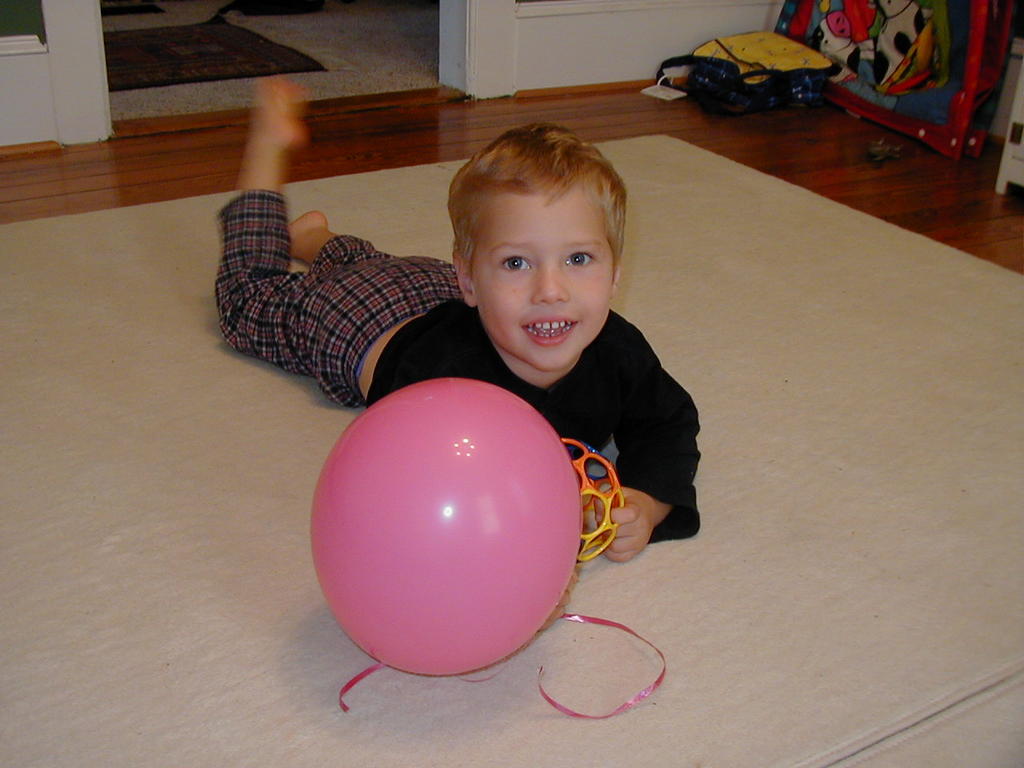
 The scene of the slide incident was a birthday party at the home of one of the children from our playgroup. I was very hesitant to attend with Oliver because he doesn't do particularly well in that kind of environment and also because I wasn't sure I was up to spending a lot of time with a group of typical three-year olds. It is too easy to compare. But Oliver did really well: no tantrums, no non-compliance, no retreating to a remote corner of the yard. In fact, he was right in there playing on the playset with the rest of the kids. Oh, and I also realized again that three-year olds are just weird, autism or no. I shouldn't have been so worried. In fact it was good for me because I tend to now pathologize just about everything the poor kid does. And what is normal afterall? I had to leave early and on my way out I ran into balding, middle-aged man picking his nose in the foyer where he thought no one was looking.
 The scene of the slide incident was a birthday party at the home of one of the children from our playgroup. I was very hesitant to attend with Oliver because he doesn't do particularly well in that kind of environment and also because I wasn't sure I was up to spending a lot of time with a group of typical three-year olds. It is too easy to compare. But Oliver did really well: no tantrums, no non-compliance, no retreating to a remote corner of the yard. In fact, he was right in there playing on the playset with the rest of the kids. Oh, and I also realized again that three-year olds are just weird, autism or no. I shouldn't have been so worried. In fact it was good for me because I tend to now pathologize just about everything the poor kid does. And what is normal afterall? I had to leave early and on my way out I ran into balding, middle-aged man picking his nose in the foyer where he thought no one was looking.
Friday, October 14, 2005
"That's a Woo-Wee"
Oliver's speech is extremely limited, consisting of about eighty or so words and phrases that he uses often throughout the day to communicate his most basic needs. Most of what he says is clear and understandable to anyone. Some of  what he says is understandable only to those of us who know him well enough to understand the context. But a lot of Oliver's vocalizations are just gibberish; what we think of as his own private l
anguage. I like to imagine that Oliver has a lot to say about the world but that he hasn't yet mastered the complicated steps involved in expressive speech -- turning his thoughts into words that mean something to the rest of us.
Sometimes Oliver will cock his head to the side at a certain angle, look me in the eye and deliver a short soliloquey two or three "sentences" in length. Usually if I don't respond the way he wants me to -- and I rarely do -- he will repeat, syllable for syllable what he just said. Now I'm pretty sure that there is no wordlike meaning to the sounds that he is making but everything about it sounds like it ought to be some language somewhere. In fact, I often feel that if I just listened carefully enough, or if he repeated it often enough, that I would eventually get what he is saying.
One other thing about Oliver: he loves his reflection. I'm not sure when that started really, but as long as I can remember he has enjoyed interacting with his own reflection. This strikes me now as ironic because autism is characterized by a lack of ability to interact socially. Children like Oliver become so stressed in social situations that they withdrawl inward to dramatic degrees. So for pleasure, and for relief from the daily demands of life, Oliver will seek out reflective surfaces. Once he finds his own face looking back at him he dances and makes silly faces and talks up a storm using Oliver-speak. I enjoy watching him at these times because somehow I think it gives me a little window into his world.
Lately Oliver has been repeating the same phrase throughout the day. I noticed it yesterday in particular when he was talking to his reflection in the oven door: "That's a woo-wee!" he would say with apparent delight. "That's a woo-wee!" The he would go tearing around the bottom half of the house until he wound up in front of the oven again. This was one of those times when I really thought I ought to understand what he was saying but it was like a puzzle with a piece missing. This has happened before and I have been so pleased when I discovered that indeed the utterance had meaning. Like the time he repeated, "Beongs seeyu" over and over again when we were playing. For weeks he would say this phrase, usually when he handed something to me. Then one day I happened to be with him at his "Gram's House" when she gave him a quick lesson about something she didn't want him to touch: "See Oliver," she said, "this belongs to me." Then she handed him some play object and said, "This belongs to you."
Or "Beongs seeyou" in Oliver-speak.
When I was pregnant with Oliver, and even during his babyhood, I remarked often to Nik that I would have liked to fast forward to a time when Oliver was talking so that I could hear what he had to say. "Beongs seeyou" and "That's a woo-wee" aren't exactly what I had in mind. But I'll take them because knowing how much Oliver struggles to find his words, I believe they sound like poetry. Even if most of his "words" don't have meaning in the way that the rest of understand vocabulary, I think he is trying to communicate something to us. And with a little luck, and if we pay close attention, we might eventually get it.
During the bustle of trying to get two fussy kids into bed and asleep tonight I was completely absorbed by the tasks at hand: bathing, dressing, brushing teeth and telling Oliver that his head belongs on the pillow for the one millonth time. He was up and out of bed time and again, stomping around his room with the now familiar refrain: "That's a woo-wee!" I was about to groan and pull the door shut behind me when I heard the train, passing a few blocks from our house, sound out the missing piece of the puzzle.
"Yes, Honey, that's a train. Now will you please put your head on the pillow!"
 what he says is understandable only to those of us who know him well enough to understand the context. But a lot of Oliver's vocalizations are just gibberish; what we think of as his own private l
anguage. I like to imagine that Oliver has a lot to say about the world but that he hasn't yet mastered the complicated steps involved in expressive speech -- turning his thoughts into words that mean something to the rest of us.
Sometimes Oliver will cock his head to the side at a certain angle, look me in the eye and deliver a short soliloquey two or three "sentences" in length. Usually if I don't respond the way he wants me to -- and I rarely do -- he will repeat, syllable for syllable what he just said. Now I'm pretty sure that there is no wordlike meaning to the sounds that he is making but everything about it sounds like it ought to be some language somewhere. In fact, I often feel that if I just listened carefully enough, or if he repeated it often enough, that I would eventually get what he is saying.
One other thing about Oliver: he loves his reflection. I'm not sure when that started really, but as long as I can remember he has enjoyed interacting with his own reflection. This strikes me now as ironic because autism is characterized by a lack of ability to interact socially. Children like Oliver become so stressed in social situations that they withdrawl inward to dramatic degrees. So for pleasure, and for relief from the daily demands of life, Oliver will seek out reflective surfaces. Once he finds his own face looking back at him he dances and makes silly faces and talks up a storm using Oliver-speak. I enjoy watching him at these times because somehow I think it gives me a little window into his world.
Lately Oliver has been repeating the same phrase throughout the day. I noticed it yesterday in particular when he was talking to his reflection in the oven door: "That's a woo-wee!" he would say with apparent delight. "That's a woo-wee!" The he would go tearing around the bottom half of the house until he wound up in front of the oven again. This was one of those times when I really thought I ought to understand what he was saying but it was like a puzzle with a piece missing. This has happened before and I have been so pleased when I discovered that indeed the utterance had meaning. Like the time he repeated, "Beongs seeyu" over and over again when we were playing. For weeks he would say this phrase, usually when he handed something to me. Then one day I happened to be with him at his "Gram's House" when she gave him a quick lesson about something she didn't want him to touch: "See Oliver," she said, "this belongs to me." Then she handed him some play object and said, "This belongs to you."
Or "Beongs seeyou" in Oliver-speak.
When I was pregnant with Oliver, and even during his babyhood, I remarked often to Nik that I would have liked to fast forward to a time when Oliver was talking so that I could hear what he had to say. "Beongs seeyou" and "That's a woo-wee" aren't exactly what I had in mind. But I'll take them because knowing how much Oliver struggles to find his words, I believe they sound like poetry. Even if most of his "words" don't have meaning in the way that the rest of understand vocabulary, I think he is trying to communicate something to us. And with a little luck, and if we pay close attention, we might eventually get it.
During the bustle of trying to get two fussy kids into bed and asleep tonight I was completely absorbed by the tasks at hand: bathing, dressing, brushing teeth and telling Oliver that his head belongs on the pillow for the one millonth time. He was up and out of bed time and again, stomping around his room with the now familiar refrain: "That's a woo-wee!" I was about to groan and pull the door shut behind me when I heard the train, passing a few blocks from our house, sound out the missing piece of the puzzle.
"Yes, Honey, that's a train. Now will you please put your head on the pillow!"
Wednesday, October 12, 2005
A Very Good Day
Today was the kind of day that makes you think that if you can have one like this every now and then that you will be able to get through the other kind just fine. It was A Very Good Day from start to just about finish. Oliver awoke with smiles to spare and we were early enough waking that we could actually spend an extra ten minutes in bed playing under the covers. The smell of a sleepy three year old boy in the morning is one of those things I wish I could bottle. After playing awhile he took my hand and pulled me towards the bedroom door indicating that he was ready to eat. So we played our little game on the stairs where I pretend that I  don't want him to jump from the top step into my waiting arms three steps down. Oliver weighs about thirty five pounds now and one of these days I'm sure I won't be pretending -- but for now it is part of our morning ritual.
Once in the kitchen we sat at his table and chairs, each with our "Yummy Cake", and sang along to our favorite Roger Day CD and Oliver snorted with laughter, as he does everytime, at the song about kissing a Rhino. Afterwards, I found his toy bus that reminds him that today is a bus day, then I wrote in his communication book -- "PM: Oliver played with Luke, took a bath and went to bed in a good mood at 8pm. AM: Woke at 6:30 smiling and happy." We then waited for the bus together sitting on the porch step in the brisk morning air. When it arrived he got on without hesitation and just a short look back at me from the top step. His look was neither fearful nor happy and as the doors closed and he took his seat I couldn't help but wonder what riding the bus is like for him. He is only on the bus for about five minutes -- you can practically see the school from our house -- but he has always liked buses ("That's a bus!" is one of his few phrases) so we thought it would be a positive way to start each day. Seeing that look though made me wonder; It's troubling to me when I can't read him.
Nik typically picks Oliver up from school at noon but I had some extra time today so I went to watch him on the playground. Lindsey was there and she has a real talent for drawing Oliver out. Today he was running with some of his classmates around the castle, up the ladder and down the slide. After coming down, the kids stood looking up inside the bright yellow tube covering the slide and laughing as the next child whooshed out. It has been so long since Oliver even acknowledged other children that I kept squinting to make sure that it was really him. And it was! There was the boy with the killer smile playing on the playground. As we were leaving Lindsey reported that Oliver was "Mr. Verbal" today and that he had no trouble transitioning from the bus to the classroom. I was particularly happy about this last thing because a walk that should take 5 minutes has sometimes taken Oliver forty-five. And finally, when we got home this evening, after Oliver had spent the afternoon at his "Gram's House", he came right in, sat down, took off his shoes and socks and then went off to play as if it were nothing.
Now I don't know why some days seem so good and full of progress and other days are, well. ... not. But we've had our string of Very Bad Days lately -- days when strangers have looked at me and I'm sure they were thinking: "Lady, can't you do something about your kid!" And days that I can't even write about because I can't find the humor in them yet -- so I think we were about due to have this one Very Good Day. And I feel sure that it will carry us through until the next one, which can't be long to follow.
 don't want him to jump from the top step into my waiting arms three steps down. Oliver weighs about thirty five pounds now and one of these days I'm sure I won't be pretending -- but for now it is part of our morning ritual.
Once in the kitchen we sat at his table and chairs, each with our "Yummy Cake", and sang along to our favorite Roger Day CD and Oliver snorted with laughter, as he does everytime, at the song about kissing a Rhino. Afterwards, I found his toy bus that reminds him that today is a bus day, then I wrote in his communication book -- "PM: Oliver played with Luke, took a bath and went to bed in a good mood at 8pm. AM: Woke at 6:30 smiling and happy." We then waited for the bus together sitting on the porch step in the brisk morning air. When it arrived he got on without hesitation and just a short look back at me from the top step. His look was neither fearful nor happy and as the doors closed and he took his seat I couldn't help but wonder what riding the bus is like for him. He is only on the bus for about five minutes -- you can practically see the school from our house -- but he has always liked buses ("That's a bus!" is one of his few phrases) so we thought it would be a positive way to start each day. Seeing that look though made me wonder; It's troubling to me when I can't read him.
Nik typically picks Oliver up from school at noon but I had some extra time today so I went to watch him on the playground. Lindsey was there and she has a real talent for drawing Oliver out. Today he was running with some of his classmates around the castle, up the ladder and down the slide. After coming down, the kids stood looking up inside the bright yellow tube covering the slide and laughing as the next child whooshed out. It has been so long since Oliver even acknowledged other children that I kept squinting to make sure that it was really him. And it was! There was the boy with the killer smile playing on the playground. As we were leaving Lindsey reported that Oliver was "Mr. Verbal" today and that he had no trouble transitioning from the bus to the classroom. I was particularly happy about this last thing because a walk that should take 5 minutes has sometimes taken Oliver forty-five. And finally, when we got home this evening, after Oliver had spent the afternoon at his "Gram's House", he came right in, sat down, took off his shoes and socks and then went off to play as if it were nothing.
Now I don't know why some days seem so good and full of progress and other days are, well. ... not. But we've had our string of Very Bad Days lately -- days when strangers have looked at me and I'm sure they were thinking: "Lady, can't you do something about your kid!" And days that I can't even write about because I can't find the humor in them yet -- so I think we were about due to have this one Very Good Day. And I feel sure that it will carry us through until the next one, which can't be long to follow.
Sunday, October 09, 2005
Seeing the Boy
I've learned a lot about autism in the past few months and even more about Oliver during that time. Autism has come crashing into our home and at times it is difficult to think of anything else. But there is more to Oliver than autism. He is still my sweet little three-year old boy with his own likes and dislikes and a tremendously loveable personality. I know this and I hope that others see it as well. I don't want Oliver to be defined by his autism and so I have been cautious about revealing his diagnosis to many. But his behavior is at its worst when he is around people he doesn't know well or in new surroundings, and it is getting easier to distinguish him from his typically developing peers. So I wonder if it is hard for others to see him as I do.
 Some might wonder how it took us so long to figure out that there was something "wrong" with Oliver. Most cases of autism are diagnosed between the ages of eighteen months and three years. Prior to that time parents will report that their child was developing normally. Oliver is no exception. He hit all of his milestones at or ahead of schedule until about the age of two. But then I started to notice that his language skills were lagging behind that of his peers. We had been raising Oliver to be bi-lingual; Nik speaking to Oliver only in his native Swiss German, and I in English. In the beginning we thought he was just taking extra long to make sense of the two languages. There were other clues though. Oliver never really tried to put on his shoes or to take his clothes on and off as other kids his age did. If I wanted him to do something I usually had to physically get him to do it. And then at about age two and a half I started to notice that he would not respond to me if I called his name or said something to him. He was unusually focused on whatever he was doing. He also started to gravitate away from people when there was a lot of commotion. At Christmas last year he famously told my sister and her family "It's time to go home now!" when he had had enough from their rowdy crew of three children. When we went to the playground he always wanted to roam the nearby woods and I spent the entire time dragging him back, trying to get him interested in what the other kids were doing. And sure, there were tantrums but nothing that didn't match what the other parents in our play-group were experiencing with their toddlers. Every time I mentioned my concerns to someone they gave me reasons to feel better. There was the bi-lingual thing. And some kids are just slower to develop than others. I wanted to believe there was nothing wrong. Even after he was diagnosed I had the daily recurring thought, hope, that maybe they were wrong. If a stranger were to sit in a room with Oliver he or she might not be able to detect anything out of the ordinary -- except for that persistent gibberish of his that takes the place of understandable language.
I mentioned in my first post that Oliver has quite a program in place and we have been so impressed with what I like to think of as Team Oliver. Besides the crew of people at his school, Oliver has four therapists who regularly visit our home to work with him either 1:1 or 2:1. The therapists, Oliver and our family and make a strong team. Lindsey, one of our favorite therapists, works both in the classroom and the in-home program. She is incredibly positive and has been particularly adept at integrating herself into our household three days a week. On Friday mornings when I am home with the boys our schedule involves taking an excursion to a local bagel shop. Oliver and I had been doing this regularly for a year and I saw no reason to stop. Last Friday as we settled into our regular booth with the boys, Oliver was already in deep conversation with his bagel and Lindsey told me how much fun she has working with Oliver. "He has an amazing personality. He is such a pleasure to work with." At first I thought that Lindsey was a skilled therapist for all ages since she seemed to be speaking directly to my concerns of late. When your child is first diagnosed with autism many things come into focus; you see habits and behaviors with a new understanding and you wonder if anyone will ever be able to see past the autism to the boy. Lindsey's comment was much more powerful and healing than she probably realized. And yes, she is a very good therapist. Oliver is an amazing boy. And Team Oliver is strong.
 Some might wonder how it took us so long to figure out that there was something "wrong" with Oliver. Most cases of autism are diagnosed between the ages of eighteen months and three years. Prior to that time parents will report that their child was developing normally. Oliver is no exception. He hit all of his milestones at or ahead of schedule until about the age of two. But then I started to notice that his language skills were lagging behind that of his peers. We had been raising Oliver to be bi-lingual; Nik speaking to Oliver only in his native Swiss German, and I in English. In the beginning we thought he was just taking extra long to make sense of the two languages. There were other clues though. Oliver never really tried to put on his shoes or to take his clothes on and off as other kids his age did. If I wanted him to do something I usually had to physically get him to do it. And then at about age two and a half I started to notice that he would not respond to me if I called his name or said something to him. He was unusually focused on whatever he was doing. He also started to gravitate away from people when there was a lot of commotion. At Christmas last year he famously told my sister and her family "It's time to go home now!" when he had had enough from their rowdy crew of three children. When we went to the playground he always wanted to roam the nearby woods and I spent the entire time dragging him back, trying to get him interested in what the other kids were doing. And sure, there were tantrums but nothing that didn't match what the other parents in our play-group were experiencing with their toddlers. Every time I mentioned my concerns to someone they gave me reasons to feel better. There was the bi-lingual thing. And some kids are just slower to develop than others. I wanted to believe there was nothing wrong. Even after he was diagnosed I had the daily recurring thought, hope, that maybe they were wrong. If a stranger were to sit in a room with Oliver he or she might not be able to detect anything out of the ordinary -- except for that persistent gibberish of his that takes the place of understandable language.
I mentioned in my first post that Oliver has quite a program in place and we have been so impressed with what I like to think of as Team Oliver. Besides the crew of people at his school, Oliver has four therapists who regularly visit our home to work with him either 1:1 or 2:1. The therapists, Oliver and our family and make a strong team. Lindsey, one of our favorite therapists, works both in the classroom and the in-home program. She is incredibly positive and has been particularly adept at integrating herself into our household three days a week. On Friday mornings when I am home with the boys our schedule involves taking an excursion to a local bagel shop. Oliver and I had been doing this regularly for a year and I saw no reason to stop. Last Friday as we settled into our regular booth with the boys, Oliver was already in deep conversation with his bagel and Lindsey told me how much fun she has working with Oliver. "He has an amazing personality. He is such a pleasure to work with." At first I thought that Lindsey was a skilled therapist for all ages since she seemed to be speaking directly to my concerns of late. When your child is first diagnosed with autism many things come into focus; you see habits and behaviors with a new understanding and you wonder if anyone will ever be able to see past the autism to the boy. Lindsey's comment was much more powerful and healing than she probably realized. And yes, she is a very good therapist. Oliver is an amazing boy. And Team Oliver is strong.
Wednesday, October 05, 2005
"I'm Stuck!"
"I'm Stuck" says Oliver appropriately anytime he is kept from doing what he really wants to do, like leap out of the car and run up the stairs to Grandma's house. He says this to let me know that I should help him out of his seatbelt and quick! Or, he says, "I'm stuck in the muck" if he really wants to do something and is being restrained from ever doing it. Like jumping into the brackish, spoiled water of the creek that runs by a few blocks from our house. And I've got to hand it to Oliver. He has only a few words but they are well chosen. Even the sound of the word 'stuck' makes it seem an unfortunate place to be.
 Over the last so many days since Autism, I often find myself wondering how much each of us has become stuck. I find that we are in a true liminal state both as a family and as individuals. We're not quite the family we were and we haven't yet found how all of these pieces will fit together to create the family that will see us through. And as individuals: mother, father, brother, we haven't yet learned how to fill those roles in this new context. For my own part in all of this I have had to stand up straight, look myself in the mirror and give my self a good talking to more than once. I am not the Reader's Digest mom who will overcome great adversity through some heroic sense of inner strength. I would like to be that mom but I'm just not. Shortly after Oliver's diagnosis I found myself struggling mightly with self-pity, frustration and anger. This is not the life I signed up for. But this is the life I was given and I was entrusted with Oliver for which I am profoundly thankful. And so I have come to understand that my job as a mother is to have love and faith and hope and humor. With those four things practiced daily I hope I will emerge from my state of becoming as the kind of mother that Oliver needs and deserves. The verdict is most definately still out.
If our life were a movie of the week, however, Oliver would most certainly be the hero. I can't imagine the daily struggles that he faces and yet he manages to spend a good part of each day smiling and, we believe, happy. Since Oliver's language is so limited it is hard to know many things about him. Parenting isn't an exact science even with typical children, but when your child is autistic and largely non-verbal you find yourself making a lot of guesses and assumptions. When Oliver was first diagnosed we comforted ourselves that at least he was physically very healthy and, we assumed, fairly happy. Upon hearing this from us, however, one of Oliver's therapists drew our attention to the writings of those who are able to describe how tormenting it is to be "trapped" within oneself by autism. This conversation has lingered in the back of my mind and each day I realize a little bit more that I don't really have a good understanding of how Oliver experiences the world or just how stuck he really feels. That realization has been hard. But I continue to believe that he is, overall, a fairly happy little boy and have hope that one day he will be able to tell us for himself.
I decided to start this blog as a way of recording and sharing Oliver's progress. The Baby's Book of Milestones that my mother gave me when I was expecting Oliver is sitting on a shelf gathering dust. I realized the other day that it had gotten shuffled to the back about the same time that Oliver stopped having milestones to record. I'm afraid to take the book out now to look at it and realize all of the things that Olver used to do and doesn't anymore. The change in him over the last year, and the loss of so many skills, has been tremendous. I think I will burn that book! Instead I will try to capture here the milestones of our family as we grow into what we will be and of our heroic little boy who it seems is stuck from time to time.
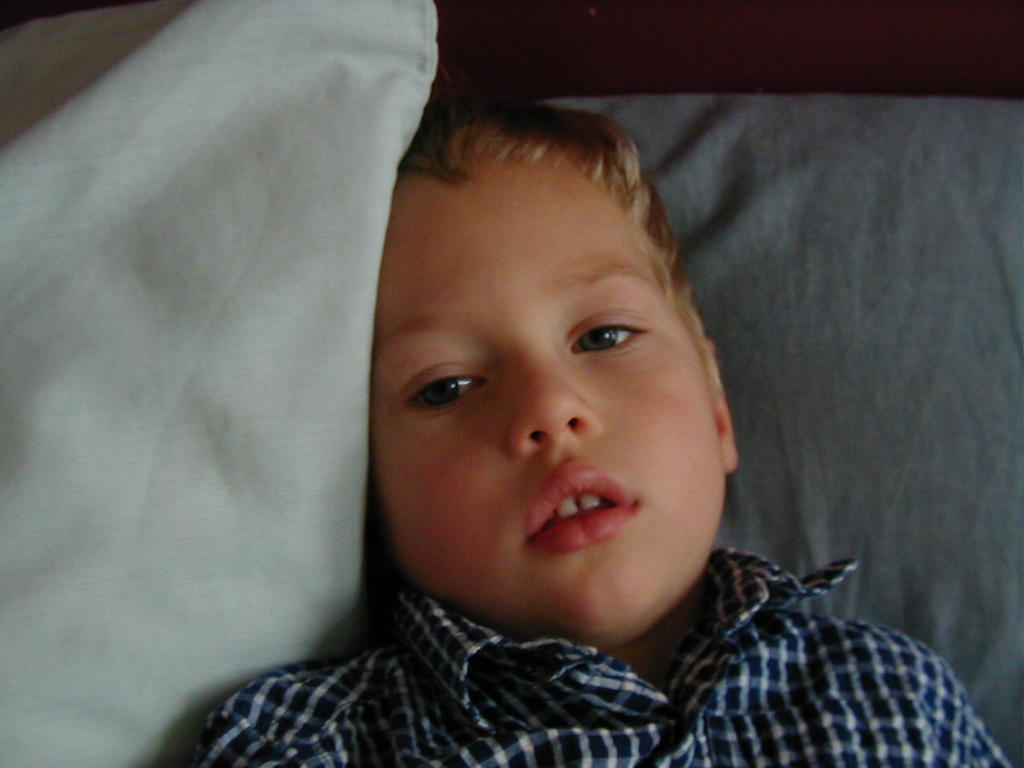 Over the last so many days since Autism, I often find myself wondering how much each of us has become stuck. I find that we are in a true liminal state both as a family and as individuals. We're not quite the family we were and we haven't yet found how all of these pieces will fit together to create the family that will see us through. And as individuals: mother, father, brother, we haven't yet learned how to fill those roles in this new context. For my own part in all of this I have had to stand up straight, look myself in the mirror and give my self a good talking to more than once. I am not the Reader's Digest mom who will overcome great adversity through some heroic sense of inner strength. I would like to be that mom but I'm just not. Shortly after Oliver's diagnosis I found myself struggling mightly with self-pity, frustration and anger. This is not the life I signed up for. But this is the life I was given and I was entrusted with Oliver for which I am profoundly thankful. And so I have come to understand that my job as a mother is to have love and faith and hope and humor. With those four things practiced daily I hope I will emerge from my state of becoming as the kind of mother that Oliver needs and deserves. The verdict is most definately still out.
If our life were a movie of the week, however, Oliver would most certainly be the hero. I can't
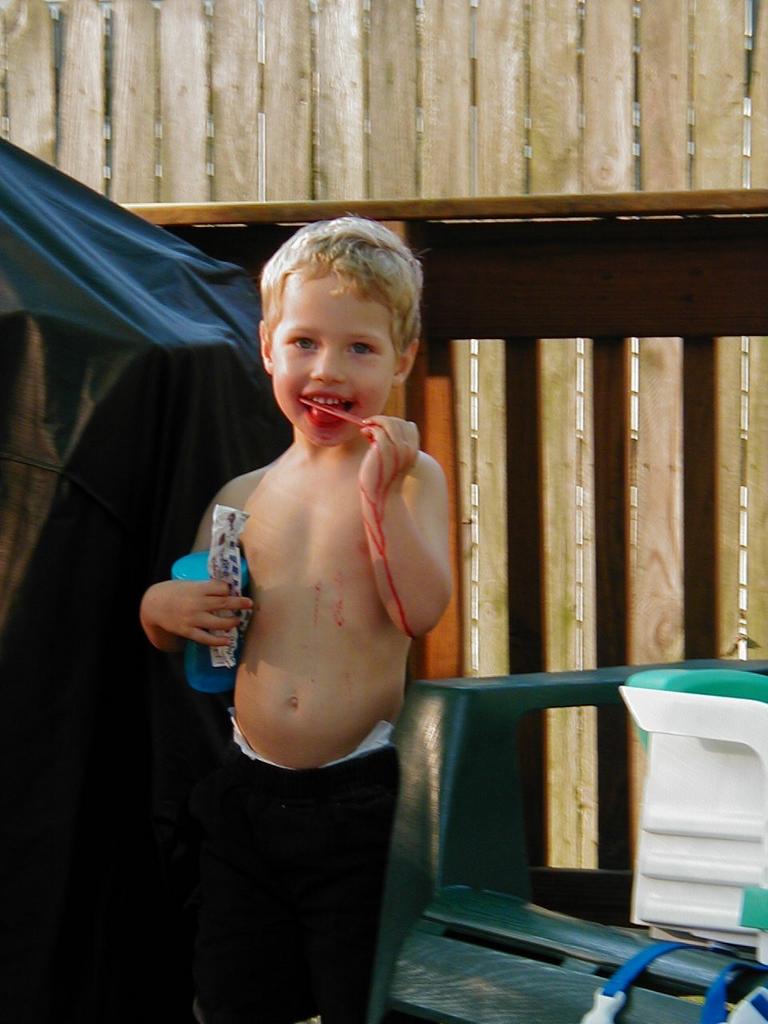 imagine the daily struggles that he faces and yet he manages to spend a good part of each day smiling and, we believe, happy. Since Oliver's language is so limited it is hard to know many things about him. Parenting isn't an exact science even with typical children, but when your child is autistic and largely non-verbal you find yourself making a lot of guesses and assumptions. When Oliver was first diagnosed we comforted ourselves that at least he was physically very healthy and, we assumed, fairly happy. Upon hearing this from us, however, one of Oliver's therapists drew our attention to the writings of those who are able to describe how tormenting it is to be "trapped" within oneself by autism. This conversation has lingered in the back of my mind and each day I realize a little bit more that I don't really have a good understanding of how Oliver experiences the world or just how stuck he really feels. That realization has been hard. But I continue to believe that he is, overall, a fairly happy little boy and have hope that one day he will be able to tell us for himself.
I decided to start this blog as a way of recording and sharing Oliver's progress. The Baby's Book of Milestones that my mother gave me when I was expecting Oliver is sitting on a shelf gathering dust. I realized the other day that it had gotten shuffled to the back about the same time that Oliver stopped having milestones to record. I'm afraid to take the book out now to look at it and realize all of the things that Olver used to do and doesn't anymore. The change in him over the last year, and the loss of so many skills, has been tremendous. I think I will burn that book! Instead I will try to capture here the milestones of our family as we grow into what we will be and of our heroic little boy who it seems is stuck from time to time.
Monday, October 03, 2005
Learning to Say Autism
Today is day sixty seven. Sixty seven days since Oliver has had autism. He has had it longer than that, of course, but its been sixty seven days since we sat in that room full of strangers whose attention was mostly taken up with the sheaths of paper in front of them. Strangers who suddenly had information about our son. Important information. They told us what they thought and we left and drove home without many words between us.
So it has been sixty seven days of waking each morning to that thunderously heavy word: Autism. In the beginning I couldn't say it. It was a betrayal to even think it. My son was perfect. He was brilliant. His first word, even before ball, was squirrel. But it has been a long time since I've heard him say squirrel and sixty seven days since I learned to say Autism.
Autism is a scary word, really. It's one of those words that makes you thankful that your kid is healthy and that its someone else's child that you're talking about. We didn't even know what Autism was. Autistic kids sit in the corner and rock, right? The first time someone suggested that Oliver might be autistic I immediately ran to the computer to read up on the subject even though I was sure she was crazy. Obsessive-compulsive behaviors, frequent tantrums, language delays, inability to pay attention. Whew, well, that wasn't Oliver. Sure, he had some of those behaviors but what two and a half year old doesn't? But then several evaluations later and a room full of people reading aloud from reports and yes, even I have to see: Oliver has Autism.
Sixty seven days after Autism and we've learned some things about our son. No, he isn't just being stubborn. He isn't just ignoring us. No, he doesn't have a discipline problem. His lack of development isn't because we do everything for him. And No, he won't suddenly start talking at the age of four like Einstein supposedly did. But there are other things that sixty seven days won't yeild up. Sixty seven days of Autism isn't enough to tell us what his future holds. Sixty seven days won't even tell us the plot. And so we are filled with questions and fear but also with optimism and most of all with hope. That last is a conscious decision and a sustained effort.
We are lucky enough to have access to a lot of skilled professionals who are helping us find our way with Oliver. He has pre-school for socialization, and then there is the speech therapy, occupational therapy, sensory integration therapy, applied behavior analysis therapy with some floortime thrown in. He is learning to communicate using the Picture Exchange Communication System (PECS) and his days are tracked using a visual schedule so he knows what to expect. At one time Nik and I used to congratulate ourselves that we weren't tied up in a lifestyle of shuttling children between engagements like so many of our friends. So it is ironic that our life is so scheduled at the moment that I have to consult my calendar to schedule a coffee date.
But sixty seven days have passed. And sixty seven more will pass exponentially. And Oliver will still have autism. But the part that we still congratulate ourselves on before closing our eyes at night is that Oliver is the same wonderful, amazing, perfect, brilliant little boy that he was sixty eight days ago.
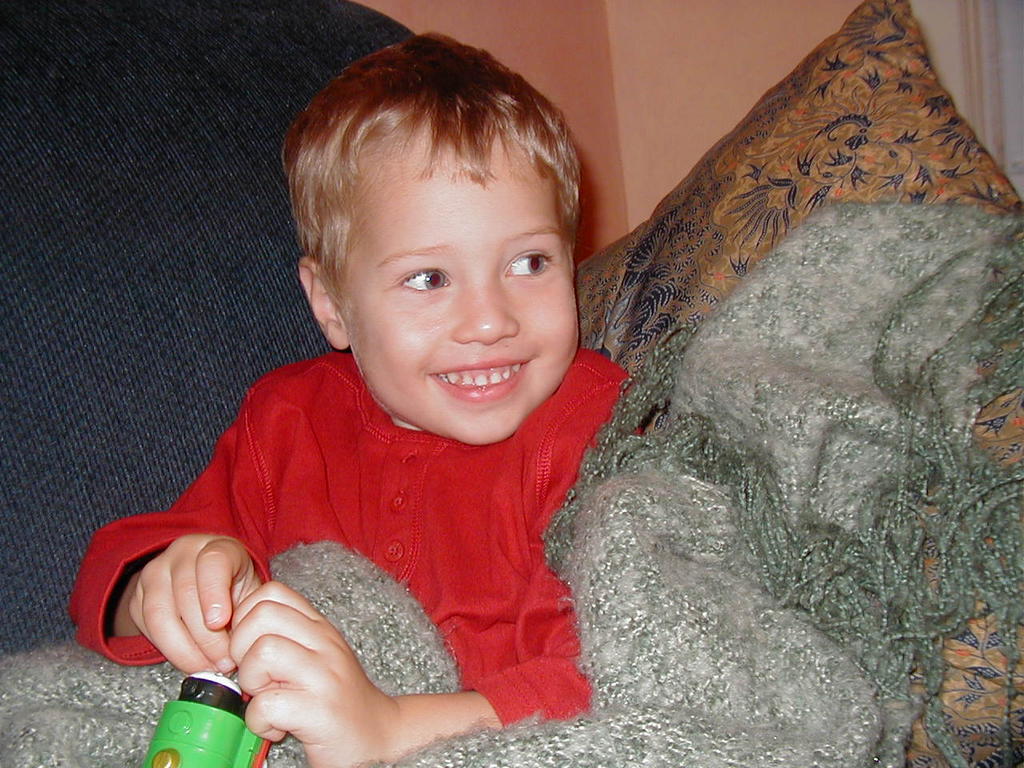
So it has been sixty seven days of waking each morning to that thunderously heavy word: Autism. In the beginning I couldn't say it. It was a betrayal to even think it. My son was perfect. He was brilliant. His first word, even before ball, was squirrel. But it has been a long time since I've heard him say squirrel and sixty seven days since I learned to say Autism.
Autism is a scary word, really. It's one of those words that makes you thankful that your kid is healthy and that its someone else's child that you're talking about. We didn't even know what Autism was. Autistic kids sit in the corner and rock, right? The first time someone suggested that Oliver might be autistic I immediately ran to the computer to read up on the subject even though I was sure she was crazy. Obsessive-compulsive behaviors, frequent tantrums, language delays, inability to pay attention. Whew, well, that wasn't Oliver. Sure, he had some of those behaviors but what two and a half year old doesn't? But then several evaluations later and a room full of people reading aloud from reports and yes, even I have to see: Oliver has Autism.
Sixty seven days after Autism and we've learned some things about our son. No, he isn't just being stubborn. He isn't just ignoring us. No, he doesn't have a discipline problem. His lack of development isn't because we do everything for him. And No, he won't suddenly start talking at the age of four like Einstein supposedly did. But there are other things that sixty seven days won't yeild up. Sixty seven days of Autism isn't enough to tell us what his future holds. Sixty seven days won't even tell us the plot. And so we are filled with questions and fear but also with optimism and most of all with hope. That last is a conscious decision and a sustained effort.
We are lucky enough to have access to a lot of skilled professionals who are helping us find our way with Oliver. He has pre-school for socialization, and then there is the speech therapy, occupational therapy, sensory integration therapy, applied behavior analysis therapy with some floortime thrown in. He is learning to communicate using the Picture Exchange Communication System (PECS) and his days are tracked using a visual schedule so he knows what to expect. At one time Nik and I used to congratulate ourselves that we weren't tied up in a lifestyle of shuttling children between engagements like so many of our friends. So it is ironic that our life is so scheduled at the moment

 that I have to consult my calendar to schedule a coffee date.
But sixty seven days have passed. And sixty seven more will pass exponentially. And Oliver will still have autism. But the part that we still congratulate ourselves on before closing our eyes at night is that Oliver is the same wonderful, amazing, perfect, brilliant little boy that he was sixty eight days ago.
Subscribe to:
Posts (Atom)